
AI-Powered Talent Intelligence for Modern Hiring Teams
A Capstone Project Case Study
2025-2026

Overview
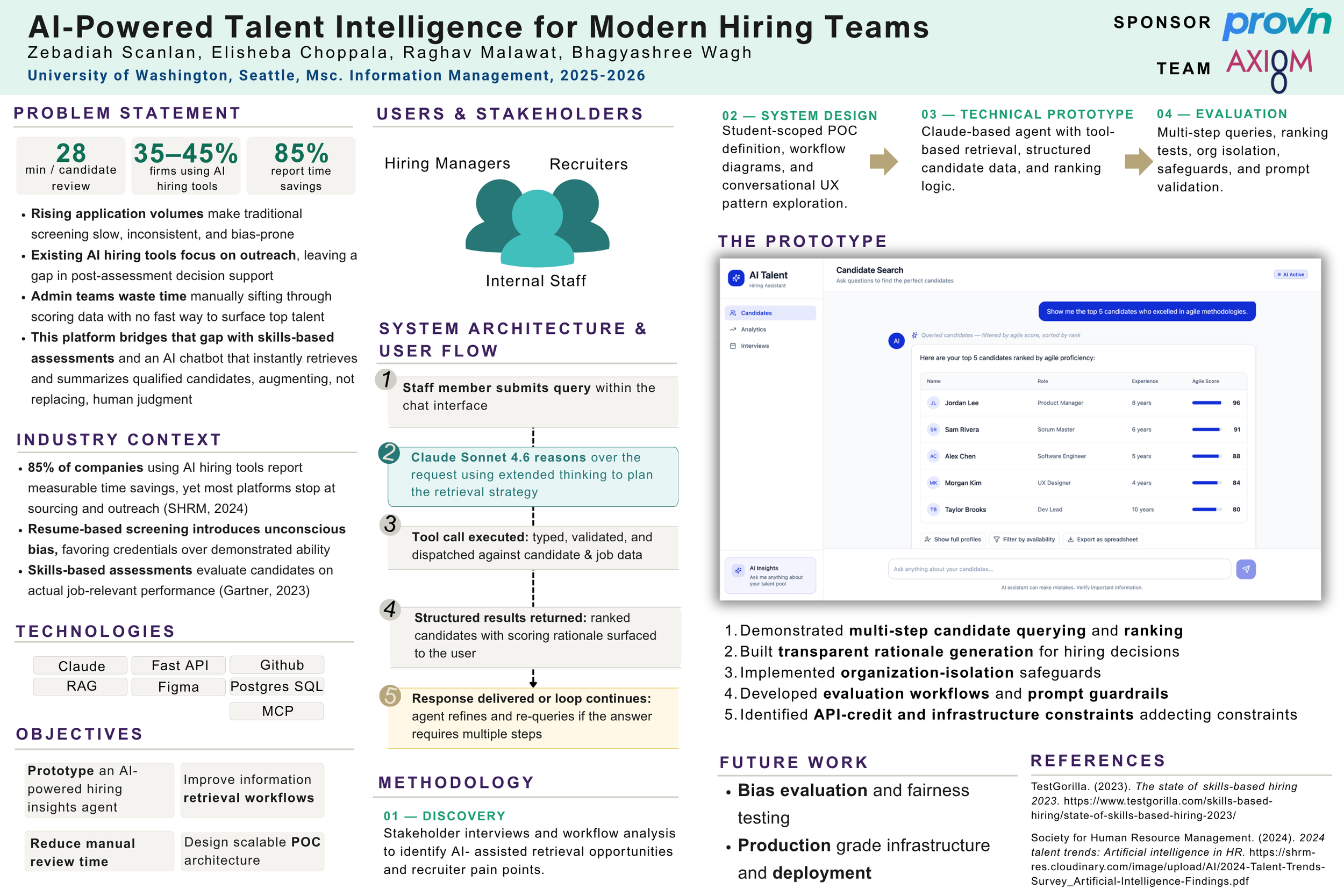
This project was completed as part of the UW MSIM Capstone program in partnership with Provn, an early-stage startup building AI-assisted hiring tools. We worked directly with team members from the Seattle based AI-startup, Provn. Our team designed and delivered a proof-of-concept conversational AI agent that allows hiring managers to query candidate data in natural language and receive ranked, explainable results. This task previously took 28 minutes per candidate review; our POC transformed this legwork into a single query.
My role was not to write code or design interfaces. My contribution was to make sure the right thing got built by the right people, in the right order, with a clear enough shared understanding to actually ship something real inside a six-month academic timeline, with a startup sponsor whose own requirements were actively evolving.
Problem
Recruitment teams face a structural inefficiency: most AI hiring tools focus on sourcing candidates (the top of the funnel), but leave post-assessment decision support entirely manual. Hiring managers are stuck sifting through scoring spreadsheets with no intelligent layer to surface who's actually qualified.
Provn had assessment data. What they lacked was a way for non-technical staff to extract insights from it quickly. The ask was to prototype something that could bridge that gap.
What made this challenging wasn't the technology; it was the consistent ambiguity. We worked with a startup partner whose product direction shifted throughout the engagement, within a team of four with very different skill orientations, and an academic deadline that didn't move.

The Value I Contributed
Stakeholder Discovery & Requirements Gathering
I led the initial discovery phase, conducting stakeholder interviews with Provn's founding team to understand their workflow, pain points, and vision. I translated those conversations into a requirements document that the team could actually build from — identifying what was in scope, what was out, and what we needed to hold firm on even as other things changed.
This involved asking the uncomfortable clarifying questions early: What does success actually look like? What are you willing to cut? What can't move? Getting clear answers upfront saved us weeks of rework later.
Cross-Functional Alignment
Our team included members with primary orientations in engineering, UX, and research. Without structure, these three directions pulled apart. I ran regular cross-functional syncs, owned the shared requirements document, and served as the translation layer between what the engineers were building and what Provn actually needed.
The biggest alignment challenge was keeping product scope, design intentions, and technical feasibility in sync — particularly when infrastructure delays meant the engineering timeline kept shifting. I kept communication flowing in both directions: surfacing constraints to the sponsor and translating sponsor priorities back to the team.
Scope Management in a Startup Environment
Provn's requirements shifted multiple times over the course of the project. New feature ideas emerged. Infrastructure access was delayed. The scope we started with in January was not the scope we delivered in June — and that was fine, because we managed it deliberately rather than reactively.
I maintained a stable core objective throughout: a working, demonstrable proof-of-concept that answered the central question. Everything else was negotiable. When new requests came in, I facilitated the team in making explicit trade-off decisions rather than silently absorbing scope and burning down timeline.
Research & Competitive Landscape
I led the literature review and competitive analysis phases of the project. This included reviewing SHRM, Gartner, LinkedIn, and TestGorilla research on AI adoption in hiring, skills-based assessment efficacy, and bias risks in algorithmic hiring systems. I used this research to frame the problem credibly for stakeholders and ground our design decisions in existing evidence rather than assumption.
Key findings that shaped our approach:
85% of companies using AI hiring tools report measurable time savings, yet most stop at outreach — not decision support (SHRM, 2024)
Resume-based screening systematically disadvantages candidates without traditional credentials (LinkedIn, 2023)
AI systems trained on historical hiring data replicate historical bias by default — explainability and fairness evaluation are not optional features (Dastin, 2018)
What We Built
The team delivered a working prototype of a conversational hiring insights agent.
A recruiter types a natural language query:
"Show me the top five candidates who scored highest on the agile methodology assessment"
The system returns a ranked list with a generated rationale for each result.
The Architecture
Claude Sonnet 4.6 (reasoning layer) → tool call dispatched against a PostgreSQL/pgvector candidate database → ranked results with scoring rationale returned to the user. The system included organization-isolation safeguards to prevent cross-tenant data access and prompt guardrails validated against adversarial query conditions.
I was not involved in building any of that directly. I was involved in making sure the team knew what it needed to do, had what it needed to do it, and was moving in the same direction at the same time.

Lessons Learned
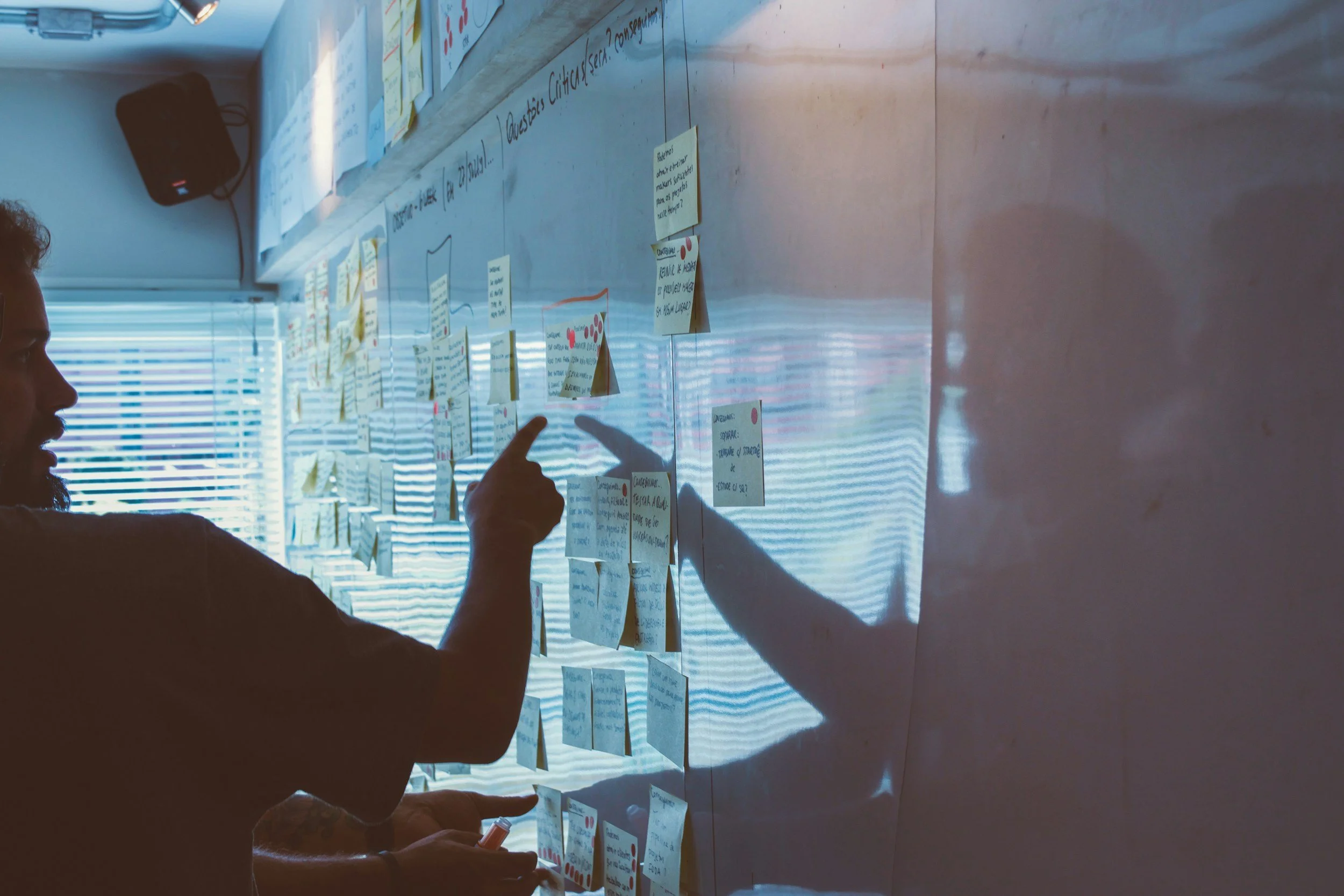
Ambiguity is a design input, not a blocker
The most important mindset shift in working with an early-stage startup is accepting that requirements will change. The teams that stall are the ones that treat incomplete information as a reason not to move. We treated it as a condition to design around.

Scoping is an ongoing discipline, not a kickoff deliverable
The scope document we wrote in January was a starting point, not a contract. Keeping it alive was one of the highest-leverage things I did across the project. This meant revisiting it regularly, making cuts explicitly, and protecting the core to ensure team alignment.

Bias toward action over perfection
When API credentials were delayed and infrastructure wasn't accessible, we built with mock data and local environments. Progress happened. When the real environment came online, we were already far enough along to move fast. Waiting for ideal conditions is not a reliable strategy.

Alignment infrastructure matters
Shared documents, regular syncs, and explicit trade-off decisions aren't overhead. They're what keep a multidisciplinary team from diverging silently and discovering the divergence too late.
Explainability is a trust problem, not a technical one
Recruiters won't use an AI system they don't understand. Building rationale generation into the agent from the start was the right call, and one I advocated for early. In any high-stakes, trust-sensitive domain, transparency is a feature.


Future Directions
The POC is a foundation. The work that matters next:
Bias evaluation and fairness testing — arguably the most important next step. AI hiring systems optimizing on historical data will replicate historical inequity by default. Amazon's 2018 experience is the cautionary baseline (Dastin, 2018). Systematic fairness auditing is non-negotiable before any production deployment.
Production infrastructure — moving from a student-scoped prototype to a real deployment environment
Multi-turn conversational memory — enabling context-aware conversations across a hiring workflow
Expanded recruiter workflows — interview prep, offer comparison, pipeline analytics
References
Dastin, J. (2018, October 10). Amazon scraps secret AI recruiting tool that showed bias against women. Reuters. https://www.reuters.com/article/us-amazon-com-jobs-automation-insight-idUSKCN1MK08G
LinkedIn. (2023). Skills-first: Reimagining the labor market and breaking down barriers. LinkedIn Talent Solutions. https://business.linkedin.com/talent-solutions/global-talent-trends/archival/global-talent-trends-may-2023
Society for Human Resource Management. (2024). 2024 talent trends: Artificial intelligence in HR. https://shrm-res.cloudinary.com/image/upload/AI/2024-Talent-Trends-Survey_Artificial-Intelligence-Findings.pdf
TestGorilla. (2023). The state of skills-based hiring 2023. https://www.testgorilla.com/skills-based-hiring/state-of-skills-based-hiring-2023/